National Collegiate Book Collecting Contest--From a Judge's Point of View
by Stuart BennettAs traders in antiquarian and collectible books, it behooves an association like the ABAA to spread the book-collecting virus as widely as possible. It's also a fine idea occasionally to take the temperature of the younger generation, to see how many might be infected.
To this end ABAA President Sarah Baldwin spent countless hours over the last two years working with colleagues at the Fellowship of American Bibliophilic Societies (FABS), the Center for the Book, and the Rare Books and Special Collections Division at the Library of Congress, in order to develop concepts and logistical support for what has now become the National Collegiate Book Collecting Contest.
Key to the implementation of the contest was securing financial aid to allow cash prizes for contest winners. In this the contest was fortunate to gain the support of the Jay I. Kislak Foundation. Already distinguished by its 2004 gift of over 3,000 books and artifacts to the Library of Congress, and its ongoing support for multiple research and education projects, the Foundation generously stepped forward to get this new project off the ground.
The first incarnation of the contest came in 2005, when Fine Books & Collections magazine decided to recognize outstanding book collecting efforts by college and university students, thereby encouraging them to further frenzies, or at least impulses, of bibliomania. Fine Books & Collections suspended the contest in 2008, and allowed the new collaboration of institutional partners, including the ABAA, to take over.
The bibliomania bug seems alive and well, though maybe not as epidemic as I, for one, might wish. Many otherwise distinguished colleges and universities do not offer prizes for book collecting. This limited the intake for the National Contest, which restricts entries to those who have already won a contest at their own institution in the same academic year as our national contest takes place.
The entries for the National Contest had to be identical to the prizewinning entries in individual college contests, but we offered candidates one additional possibility. If they owned more material than they were allowed (or chose) to describe for their college contest, and wanted to add it to their National submission, they could do so provided the material was owned at the time of the original college submission. We did get some interesting additions on this account. But - and this is critical - the collections described had to have been acquired solely by the contestant. No inheritances, no (or maybe better to be honest and say "no evident") parental or professorial direction.
A three-person panel from FABS narrowed the National Contest entries to ten finalists, whereupon John Cole from the Library of Congress, Robert Jackson from FABS, and yours truly final, collaborative, and unanimous decisions on the prizewinners. It's worth recapitulating some of the key judging criteria, as these final decisions were not easy.
The judges were required to consider
...the intelligence and originality of the collection and the potential of the entrant to evolve the collection and develop new collections....Age, rarity and monetary value of the material in a collection are less important than the how well a collection has been conceived and realized.... Uniqueness of items will be considered independently of market value, especially if the contestant can show the collection helps to preserve material that may otherwise be lost or forgotten. How intrinsically significant, innovative and interesting the collection will be determinative.
All of the finalists deserved prizes, but we had only three to offer, plus another prize for the most successful essay exposition of a collection. As a judge I was pleased that the criteria included the potential for a collection's evolution, since it seems to me that part of the value of such a national contest is to encourage continuing collecting. If a collection seems to have a narrow focus, or to be essentially complete as submitted by a contestant, then this criterion suggests that completion or narrow focus may count against that submission. Uniqueness and the preservation of material that otherwise might be lost were important plusses.
With these criteria in mind, we judges awarded first prize to Andrew Fink of the University of Puget Sound (Tacoma, Washington) for his collection An Interdisciplinary Survey of 20th Century Propaganda. Mr. Fink's wide-ranging interests and determined acquisition of material (going as far as to rescue one piece from a college restroom) were evident throughout his submission, and his enthusiasm was contagious. It infected us judges, and we hope his obvious bibliomania will infect friends, colleagues, and loved ones for many years to come.
Both Ryan Julian of the University of Chicago (History of Mathematics) and Philipp S. Penka of Harvard University ("Temporary Spiritual Sustenance": The Print Culture of Russian Displaced Persons in Post-War Germany (1945-1951)) submitted admirable expositions of their collections. In the end I believe it was the possibilities for further development inherent in Mr. Julian's collection that won him second prize, but Mr. Penka's compelling and elegantly-written description of Post-War Russians clinging to their culture in Germany was a very, very close runner-up.
Bailey N. Pike of the University of Illinois at Urbana-Champaign (The Mythology of Mozart) was another elegant essayist, and her description of her assemblage of modern material - largely books but including works in other media - displayed the possibilities available to young collectors bitten by subject-specific collecting bugs.
All in all the submissions received were an impressive lot, the more impressive for being offered to the very first National Contest organized by FABS, the Library of Congress, and the ABAA. I was honored to have been one of the judges, and I hope the success of the contest will encourage the Kislak Foundation to continue its support, and also for individuals, including ABAA members, to consider donating to the cause, and for more and more colleges and universities to encourage the bibliomaniac disease by initiating their own book-collecting contests in years to come.
Awards Ceremony Delights Winners and Guests
by Sarah Baldwin
Bailey Pike (Essay Prize Winner), Philipp Penka (3rd Prize), Andrew Fink (1st Prize), and Ryan Julian (2nd Prize).
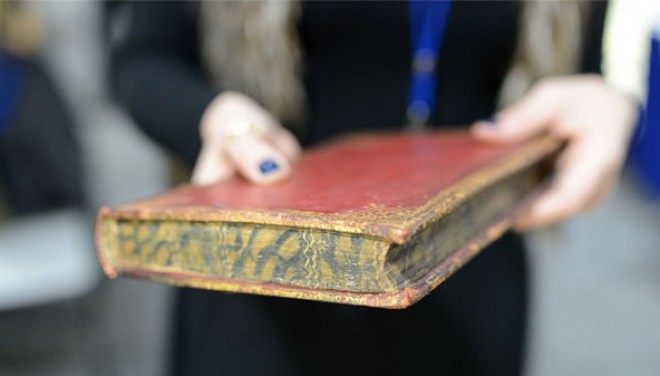
Mark Dimunation holds The Leaves of Grass and A Week on the Concord and Merrimack Rivers.
Carol Fitzgerald opened the awards ceremony proper with an illustrated talk, "Collecting Mid-Twentieth Century Regional Americana." She described how a chance purchase of a Rivers of America title at a Miami, Florida book fair in the 1970s led to her compiling a collection of The Rivers of America series and then of The Series Americana. She noted, more than once, the valuable contribution of John Townsend of Town's End Books to the formation of her collections. (Oak Knoll, in collaboration with the Center for the Book, has published Carol's impressive The Rivers of America; A Descriptive Bibliography and Series Americana; Post Depression-Era Regional Literature, 1938-1980).
John Cole announced the prizewinners, encouraging each to describe what sparked their collecting, with Arthur Dunkelman presenting the prizes on behalf of the Jay I. Kislak Foundation. The intelligence and eloquence with which each prizewinner spoke of his or her collection delighted all those gathered to celebrate. CNN recorded the talk and ceremony for later airing on C-Span; and, the talk and ceremony will also be viewable as a webcast at the Center for the Book site Read.gov.

A captivated audience.
Book collecting, amid e-books, digitalized texts, and PODs, continues to intrigue and engage a new generation of collectors. The cosponsors of the National Collegiate Book Collecting Contest hope it will continue to nurture, challenge and reward young collectors and thank all who have made the Contest possible through their donations and their support. For more information on how to support the Contest, please see Contest.abaa.org.
Photos by Abby Brack courtesy of the Library of Congress.